![]() |
| Could the Menehune still live in the mountain forests of the Hawaiian Islands? By Heath Cajandig - Heart of Kauai, CC BY 2.0, |
![]() |
Beasts of the World is a seven-part series, which seeks to investigate the histories, evidence, and common theories surrounding the numerous cryptid creatures that have been reported around the globe.
![]() |
| Could the Menehune still live in the mountain forests of the Hawaiian Islands? By Heath Cajandig - Heart of Kauai, CC BY 2.0, |
![]() |
![]() |
| Irati Forest, Navarre, Spain. |
The long tradition of orderly historical record-keeping, inherent in the cultures of the former vassals of the Roman and Greek empires, has left a detailed and largely intact smorgasbord of wildman representations throughout Europe, that is found, not only upon the ancient edifices of our holy houses but also woven into the clannish standards of our noble families and inculcated into the illustrations of our ancient animaliums. This, in combination with the large literary and oral history of human encounters with the wodewose, or wildman; means that the average researcher, spoiled for choice, can choose instead to focus on individual cases or regional wildman varieties, finding sufficient fodder in the single as one would in the whole. Within this bygone pantheon, the Basajaun of the Basque nation (Euskadi) that straddles southwest France and northeast Spain, is a minor player, but nevertheless important, due to its honorific title: “Lord of the forest” or “Forest man”, in which its contiguous affiliation with its semi-mythical continental cousins is confirmed.
What’s in a name? The name, Basa-Juan is a composite title, combining the Basque words - Baso (forest) and Jaun (man); which, when united, render the all too familiar habitational title present throughout crypto-hominology of: “Man of the Woods”, "Lord of the Woods", or “Forest Man”, etc. It is, in concurrence with other wildman legends, likewise branded with other appellations throughout the region, such as Anxo, Basandere (woods-woman), Bebrices, Iretges, Mono careto (ugly ape), Nonell de la neu (Catalan – Nonell of the snows), Peladits (finger peeler), Tartalo (Cyclops), Torto, and Yan Del Gel; attesting to its ethno-known, or at the very least, long folkloric tenure in Basque culture.
Monstrous Measurements: In the Basque folk tradition the Basajaun is a mostly peaceful giant that possesses great strength and agility. It is bipedal, standing 5 – 10 ft. tall, with a large, man-like body that is covered in long, reddish, or dark brown hair that hangs down to its knees, sometimes even reaching its feet. The male (Basajaun) has a beard, the female (Basandere) does not.
Terrifying Tracks: Leaves ‘mysterious tracks’ that do not match any known local species, or; circular tracks shaped like the hooves of a cow.
Beastly Behaviours: Legend has it that the Basajaun protects flocks and warns shepherds of incoming storms or roaming packs of wolves through loud yells, whistles, and hollers, in return for bread, which it collects while the shepherds are asleep. It is generally benevolent, but also carries a large stick or a club and occasionally abducts shepherdesses. Screeches like a cat when angered or distressed. Reputed in Basque folklore to have taught blacksmithing and agriculture to men. Wears animal skins.
Deadly Diet: Grasses, roots, and game animals.
Hairy Habitat: Lives in caves, deep in the woods. Believed to inhabit the forests of Ataun and Gorea in the Basque region; the Irati jungle in Navarre; Maladeta Massif, Aragon; and especially the Pyrenees Mountains of France and Spain.
Scary Sightings:
1774: Engineer, Julien
David Leroy wrote in his work on logging in the mountains of the Pyrenees that,
the pastors of the Iraty Forest region of Saint-Jean-Pied-de-Port and its
neighbouring areas along the border with Spain, claimed that a shaggy-haired Wildman, superficially resembling a
bear, was known to inhabit the region.
Unknown Date: Local folklore holds that long ago, 2 hairy brothers, named Iretges, lived in the woods near Bedeilhac-et-Aynat, Ariege Dept. France. The brothers wore animal skins and were notorious for abducting shepherdesses; until one day, the villagers, tired of their depredations, lured them into a trap and killed them.
1979: Six woodsmen encountered a 6ft. tall ape-man in a sparsely-populated area in the Pyrenees Mountains of Huesca Province, Spain. After hearing a scream and squealing nearby, one of the men, Manuel Cazcarra went off to investigate, only to discover a hairy man-beast, 6 ft. tall, standing before him. The creature perhaps alarmed by Cazcarra’s sudden appearance, climbed up a pine tree, where it stayed, clutching a branch with its arms and legs, and seemingly berating the man with its loud screams. Cazcarra called the other men, who came running up, one of them, Ramiro López, who was just in time to see the ape-man climb down from the tree and hide behind a dense bush, before suddenly launching a hefty tree branch in their direction. The men decided not to pursue the creature further. The two men who had witnessed the creature were experienced woodsmen and were familiar with the bears that inhabit this region and swore categorically that the animal they had seen was not a bear. One week later, The Guardia Civil (Spanish Police) accompanied by one of the woodsmen, returned to the area and found ‘mysterious footprints’. Shortly afterward, a family driving towards Prats de Molló witnessed an ape-like animal, crossing a road close to the French border.
1993: A group of cave researchers (Speleologists) decided to spend the night at a ruined church near Collada de Vallagrasa in the Catalan Pyrenees Mountains of Spain, when they heard strange noises that sounded something like those of an enraged cat. Approaching the source of the clamour near the church door, they were astonished to see a bulky, man-like creature, 5ft. tall and covered in shaggy hair that appeared to be frightened and agitated. Upon seeing the group, it fled into the woods. Later, the same wildman was seen again in the woods between Fargo De Bebie and Ripoll, Gerona.
1994: A mountain climber named Juan Ramo Ferrer saw an apelike creature, while hiking from Peña Montañesa to the village of Bielsa close by. The strange creature, which was shorter than a man and covered with reddish hair, with very long ape-like arms, jumped from tree to tree and squealed at the terrified hiker, who fled to a local campsite near Peña Montañesa. According to Ferrer, his hirsute harasser, “exuded a musky odour.”
Unknown Date: Two Wildmen pounced upon two paleontologists and struggled with them briefly before running away.
Beastly Evidence:
Art and Archaeology:
Isturitz Cave Art: The Isturitz and Oxocelhaya caves in the Arberoue Valley in the foothills of Pyrenees, in Lower Navarre, southwestern France, are a site of Paleolithic significance and contain the physical, material, and artistic remnants of both Neanderthal and Homo sapiens societies that have been deposited within their insides, between 60,000 and 600 BC. In the cave of Isturitz, one can even see a rupestrian engraving of what appears to be hairy, of a wildman, in profile.
Isturitz carved bone: Another possible representation of the wildman was found in the same cave and features two hairy hominoids that are not Homo sapiens. One of the hominoids has an arrow in its leg and links around its neck and leg, possibly indicating that these creatures were killed by hunters.
Wildmen grew in popularity during the medieval period, where they are depicted as wild, hair-covered men, upon the architectural adornments of cathedrals, tapestries, and in the heraldic coats of arms of prominent European families.
Literature:
Basa-Jauna, The Wild Man: A folk tale from the Basque region tells the story of a Basque farmer’s wife with 3 sons and a daughter. Her sons leave home to seek their fortune and become enslaved by a Basajaun and Basandere (husband and wife) in exchange for not being eaten, after seeking shelter at their castle, one night. Years later, their sister, finding out that she had once had three brothers who disappeared, goes in search of them, and, seeking shelter at the same castle, also becomes enslaved by the Basajaunak, who vampirically drains her life force by sucking on her finger. After several twists and turns, including her brothers becoming oxen for a while, she threatens to roast the Basandere who sends her away to find some hazel sticks, and in a characteristically predictable old-world tale of family misfortune turned unlikely happy ending, she and her brothers, end up living happily alongside the Basajaun in their castle… This somewhat mediocre tale is too long to include in full here and ends rather abruptly, yet nevertheless, testifies to the folkloric antiquity of the Basajaun and remarkably, is the only case where it is represented with vampiric qualities.
Beastly Theories:
Relict Neanderthal: It is now known that the Iberian Neanderthals persisted around the area of the Ebro River in the Pyrenees (which encompasses much of the modern Basque region) until relatively recent times. Do the hairy portrayals that both Neanderthals and Bajaunak share prove human and Neanderthal coexistence in the Basque region? Could modern-day reports be those of a surviving Neanderthal? Sadly, I think not. The average Neanderthal man, stood at an unimpressive 5 ft. 5 inches tall; which sits right at the lowest height range for the Basajaun. Furthermore, Neanderthal is now known to have been skilled in stone tool use, as well as weaving, fire, art, seafaring, music, and so on; which doesn’t make it a particularly good fit for the modern wildman type, that eyewitnesses usually describe seeing; but does constitute a closer fit with the fabled megalithic builder and protector of flocks, that the folkloric Basajaun was reputed to be.
Neolithic Migrants: Some authors have suggested that the Basajaun myth is a folk memory of early human contact with migrating Neolithic settlers? These peoples, clad in furs and skins, and accompanied by flocks of domesticated animals, were megalith builders, who would have brought agriculture, domesticated animals, and new tools to the region. Indeed, there is a Basque myth that speaks of Saint Martinico (Martin Txiki) who through trickery and ingenuity, stole these technologies from the Basajaunak and imparted them to ‘mankind’.
Unknown Ape Species: Could an extant form of ancient ape, like Paranthropus robustus an extinct australopithecine, from South Africa or Dryopithecus, an extinct Miocene ape from east Africa and Eurasia, be responsible for historical encounters with creatures like the Basajaun and other European Wildmen? Besides their hairy appearance and gracile nature, the Basajaun and other European Wildmen seem to be more man than ‘monkey’, as is evident from their multitudinous depictions, which adorn European cathedrals and noble heraldry throughout the medieval period.
![]() |
| The god Pan (pictured here with Daphnis) an ancient embodiment of the Wildman? |
Faunic
Folklore: The European Wildman’s behaviour and
appearance are closely related to and possibly inspired by other mythical
entities of Europe, such as the Satyr, Faun, Ogre, and Leshy; which are
similarly described as shy, forest-dwelling, hair covered beings; who are not
beyond carrying off the occasional maiden, from time to time! One would also be
remiss, to overlook the similarity it bears to the pagan hero, Heracles. This
enigmatic fellow is regularly depicted as a powerful, hair-covered, club-wielding
man, whose recycled origins and myriad names transverse most of pagan history. Therefore,
it could be contended that the image of Heracles (or Hercules) is ingrained upon
the cultural memory of the peoples of Europe and the near east and that the Wildman
is but a watered-down amalgamation of this deified character and that of Pan, (Silvanus)
the ancient Greek god of the wilds, and protector of shepherds flocks, who is
thus represented as a hairy bearded man with the legs of a goat and carrying a
shepherd’s staff.
Note: Some ancient representations of
Balkan shepherds depict bearded men, carrying staffs, and wearing fleece
trousers made from goat’s hair.
Written by Andy McGrath
The Basajaun is an excerpt from Beasts of the World: Hairy Humanoids
Listen to the audiobook here:
What is a Duende?
Duende is a Spanish word for “goblin or “dwarf” and is etymologically derived from
dueno de casa (lord of the house),
referring to a Spanish household spirit. Duendes feature in written and oral
traditions in Latin America, Spain, and Europe and are described as being of a
small stature, 1.5 to 4.5 feet in height, broad shouldered and covered in thick
hair. They have large teeth and pointed ears and their faces are wrinkled. They
have long beards and are reputed in some regions to wear a big hat. The Duende
is reputed to whistle a mystical song, while walking in the forest.
![]() |
Spanish and Portuguese folklore is replete with tales and legends about various types of duendes which sport numerous regional names and behaviours. In these countries we see again that Duende is often a coverall term for elf like creatures that are described as small hairy gnome like beings, clothed in red or green that can help around the farm/home or hinder, depending on the mood or relationship one has formed with the creature.
They are often said to dwell in mountains, underground hollows, near ponds, and, not unlike
the Irish leprechaun and other legendary little people – they can be found guarding
great treasure. They also have a disposition for stealing possessions or
children and a love of milk or cream that is observed in many other members of
the European fae family. They are also described as beautiful and benevolent
nymphs or fair faced human sized faeries.
Conversely, in some Latin American cultures, duendes are believed to come to the aid of people who get lost in the forest, helping them to find their way home. These gnome-like creatures who live inside the walls of homes, especially in the bedroom walls of young children, allegedly attempt to clip the toenails of unkempt children, occasionally leading to the erroneous removal of entire toes!
Belief in duendes still exists among the Mixtecs and Zapotecs of
Oaxaca and it is said that they are most commonly found in the mossy cloud
forests of the state's mountain ranges. In the jungles of Belize, for example,
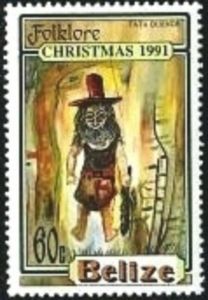
there is a superstition of a repulsive gnome, called Tata Duende; that punishes
those who do not respect the forest.
Digital Folklore Revival
There have been a rash of ‘alleged' encounters posted online since the noughties; usually featuring teenagers, or children; or families with children who whilst casually filming their own activities, manage to capture a Duende on film scuttling into view. Of course, as might be expected with such inconclusive forms of evidence, most clips cut short shortly after the creature is spotted, and are annotated by the uproarious and terrified screams of the witnesses; who rush to post their encounters online... Whatever conclusion one comes away with after viewing some of this footage, what cannot be doubted is, that the Duende superstition is still alive and well in Central & South America.
Sightings
One of the
most well-known Duende sightings by far happened in 2008 in the town of General
Guemes, in the province of Salta, Argentina, a country steeped in stories of
the creatures. The sighting was made by a group of teenagers who were hanging
out one evening after a fishing trip when they saw a tiny man dressed in a
wide, pointed hat emerge from the dark to do a strange sideways shuffle across
the road. One of the teenagers, a Jose Alvarez, actually managed to capture the
strange being on his cellphone camera, and said of the bizarre encounter:
“We were chatting
about our last fishing trip. It was one in the morning. I began to film a bit
with my mobile phone while the others were chatting and joking. Suddenly we
heard something — a weird noise as if someone was throwing stones. We looked to
one side and saw that the grass was moving. To begin with, we thought it was a
dog, but when we saw this gnome-like figure begin to emerge we were really
afraid. This is no joke. We are still
afraid to go out, just like everyone in the neighbourhood is now. One of my
friends was so scared after seeing that thing that we had to take him to the
hospital.”
The video clip certainly shows a rather unsettling and
creepy gnome-like being doing a strange sideways walk, but it is very short
and not particularly clear, leading many to say that it is likely a hoax. Other
speculation has been that it is an actual human with dwarfism playing a prank
on the boys or even that it is a genuine Duende. The odd sighting came amongst
some other sightings of the creatures in the area at around the same time, and
there have been commenters on various paranormal sites who have analysed the
video and come to the conclusion that whatever it is, it is not CGI. . https://youtu.be/PI3V0qn3I5M
Argentina has
been the source of quite a few rather frightening encounters with evil gnomes.
In 2011 the area of Suncho Corral, Argentina experienced a wave of sightings
and encounters with a Duende that seems by all accounts to have been quite
malevolent. The creature in question was said to have the typical big, pointy
hat, as well as large, elfin ears, and was blamed for a series of at least a
dozen vicious, unprovoked attacks on children and the elderly walking alone at
night, which the entity purportedly shoved, kicked, and punched. In some cases
it was reported that the mystery creature actually knocked kids off of their
bicycles, and some people were reportedly beaten into unconsciousness by the
fierce gnome. The police were allegedly received so many complaints from
terrified residents that they declared a state of emergency and
implored people not to go out at night.
One of the
most bizarre cases of all in recent years of Duendes is a 2016 account from
Nicaragua in which a woman made the incredibly odd and dramatic claim that she
was kidnapped by the creatures and kept captive for 5 days and 6 nights. The
woman, known only as Jasmina, claims that she was out playing near her home in
Monte Oscuro, Nicaragua, when a group of the menacing little entities appeared
and lured her up a hill, where they abducted her and put her in the cave.
According to the report, her family sought advice from a local witch and were
finally able to locate her. The original report says that 15 years earlier
another girl had been kidnapped by the creatures and held captive in the very
same cave. Apparently these gnomes or goblins are a serious problem in the
area, with one local saying:
“Currently there are
many of these creatures living in San Silvestre and in Peor Dicho, in Monte
Oscuro and in La Gualapa. There are a lot that live in San Silvestre and around
it, they stay away from the church and they also exist in other areas nearby.
In San Jose they live in another hill there, and they communicate from hill to
hill.”
Beastly Theories
Colonial Cryptid
Footprint: It is quite obvious to
any objective observer that Duende tradition and superstition is rooted in
Europe, particularly in Spain and Portugal and that its dissemination
throughout the Spanish and Portuguese speaking countries in central and South
America, and as far away as the Philippines, is proof positive of the cultural
and superstitious assimilation, or melding, of colonised populations with the
folklore of their colonisers. In Central and South America, these traditions
are thought to be a mix of European elven folktales and Indian trickster myths.
Though, I think it more likely that these Indian trickster myths were replaced
by Duende folklore and have over the subsequent generations taken on more of the character of their
European replacements.
Allopatric Speciation: Allopatric speciation, also referred to as geographic speciation, vicariant speciation, or its earlier name, the dumbbell model, is a mode of speciation that occurs when biological populations become geographically isolated from each other to an extent that prevents or interferes with gene flow. Darwin’s finches are one well known example of this. Another, obvious example would be the 8 extant species of bear that we know of. Could the Duende in Central and South America simply be another species of a diminutive bipedal primate or proto pygmy, once ethno-known throughout Europe and now hanging on to existence in less industrialised areas of the world? Did Europeans encounter little people legends in the Americas that were so close to their own, that they simply replaced local Indian names with their own cultural cognomens for these cryptid creatures?
Other alleged Duende clips, photos and eyewitness accounts can be found below: https://youtu.be/RnogZWf76ik https://youtu.be/mX9CEOKRAZs https://youtu.be/3QSDhSpG_Jw https://youtu.be/mVOTPxPzvcU
Written by Andy McGrath
| Eyewitness sketch of the1 metre high bipedal primate witnessed by Mateo Camelo on the roof of Gary Opit’s property, in Nimbin, New South Wales. |
![]() |
| Lycaon. From Ovid's Metamorphoses Book I, 209 ff |
“We weren't way out, but were tent camping in a horse camp
that sees a fair amount of use. It got dark around 7pm and all the wood was too
wet to start a fire; so we we’re lying in the tent enjoying the quiet, when I
heard footsteps around the back side of our tent. “
“At any other time, I would've dismissed it as a wolf or
coyote, because they're everywhere around there. However, that night 2 fellow
campers had gotten into a fight, which end in one of them leaving the site and
as the one who remained was very intoxicated and antagonistic, I became worried
that he was sneaking around our camp.”
“I said in a loud enough voice ‘if you don't get away from my tent and stop messing with me, I'm going
to kill you!’ I'm not real proud of that but we were out far enough that
help wouldn't come soon, so I was really just trying to intimidate him. “
“A couple more minutes go by and I hear more steps and this
time I hear the door handle on my Nissan (Car) get pulled in. It's a really
distinct sound and by this time I was really paying attention because I thought
our intoxicated neighbour was already in my camp.”
“So, I come out of tent pretty quickly and pretty
aggressively, but there’s nobody there. Not only that, but the guy I think is
messing with us is 50 yards away by a fire with his girlfriend. So I shine a
light around, don't really see anything & tell myself that maybe I’m
hearing a deer we’d seen walking around in the treeline, before sundown.”
“This has been going on for just 15-20 minutes now and I'm starting
to feel a little nervous. So, I go back in the tent, but this time I adjust the
rainfly a bit, so I can see outside and try to catch a glimpse of whatever it
is that I keep hearing.”
“Within a couple minutes, I hear more steps. There's a
really bright moon in the sky. I roll over and look out of the opening I made
in the rainfly and I see I don't know what? It didn't look or move like
anything I'd ever seen before. I continue to watch from inside until it moves
out of sight and I bolt back out of the tent to try and see what it is?”
“I ran in the general direction I saw it go, it but it's
gone. As I'm standing next to the tent shining the light in the woods, I
realise I'm looking at a large figure and it's walking straight to me. I did
not believe in Bigfoot until that exact moment in time! “
“So, this horse camp is essentially an opening into
thousands of acres of woods and there's nowhere to run. I spin around in a
panic and dive back into the tent and zip it up. The figure was roughly 30 feet away when I saw
it and I can hear his footsteps smashing the frozen ground, as he’s coming
right to the tent!”
“He, I believe the creature was male, walked up to the back
corner of the tent, stood over it, grunted, hit his chest and growled at me. I
was frozen! This thing was massive! I'm confident at least nine to ten feet
tall and a thousand pounds. “
“As he's intimidating me and I'm lying there frozen; the
juvenile (smaller figure) that started all of this was sniffing me, right next
to my head. Their silhouettes were clear in the moon light as they stood over
the tent, the big male’s shoulders seemed as wide as I am tall. I'm not a small
man, but next to this thing I was tiny.”
“This was when he started making strange noises at the
juvenile. It was a very parenting tone. There was a lot of body language
involved and he spoke in a series of clicks and pops with his tongue. It wasn't
just nonsense because the juvenile was responding back with sounds too, which
sounded more like a squealing noise. There were a couple of back and forth
communications like this between them and then the juvenile headed into the
woods with the adult right behind him.”
“Shortly after this, I heard a loud cry or scream and a real
loud whoop noise, followed by over a half dozen different calls in reply coming
from all around the woods.”
“Previous to this experience, I believed that people who
talked about creatures like Bigfoot were just engaged in wishful thinking and
that if such things existed then we'd surely have evidence?”
“I can tell you that I was so scared to death that my fight or
flight instinct chose freeze, that night. I'm 6'2" tall and a healthy 200
pounds, so I've never really been intimidated just by the size of something.
However, this "being" just radiated power that I've never felt or
seen before. He was there the entire time and I had no clue until he came up out
of the woods and I immediately went into ‘timid
mode’. “
“I knew he was the superior being between us and that he could crush my spine with minimal effort. That said, he decided not to. He felt that my cowering in the tent was enough. I'm glad they are intelligent enough to make decisions like that...”
I hear so many amazing Bigfoot encounters and this one is
not as unusual as one might think. A curious juvenile being shadowed or watched
over by an adult who stays hidden, but watching at a respectful distance,
while the juvenile explores. The protective actions of a big male that
intimidates anything that poses a threat to the ‘child’ and yet stops short of
inflicting any harm.
Also, the witness’s claim to witness a rarely observed behaviour...Sasquatch
speech, is very intriguing! There are very few accounts of this and I would
theorise that it was possibly revealed possibly due to the parental situation
of having to instruct ‘a child’.
The reported curiosity and restraint of these creatures does
seem to show a remarkably intelligent animal and judging by the physical power they
seem to possess, we're quite fortunate that they are not quick to use it.
Written by Andy McGrath
Inuit Legends of the arctic tell of large 'Bigfoot-like creatures, known as the Tornit or Alaskan Bushman; that inhabit Alaska's North Slope.
The creatures are reported as being bipedal, reaching 10 feet in height and being either black, brown or greyish, in colour. Large human-like footprints are found in areas where the creatures are reported to live.
The Alaska Bushman is said to love the tundra, unlike its cousin, the Sasquatch, which is usually reported in the vast forests of the Pacific Northwest and is also reputed to have a taste for meat, preying on caribou and other animals. One family who hunt Caribou each fall, from their cabin, between the towns of Barrow and the community of Atqasuk, claim to have had several encounters with the creatures; even claiming to have witnessed a Tornit/Bushman chasing a herd of Caribou about a mile from their cabin, reporting that they saw - 'A big herd of caribou coming towards them, when suddenly a big black creature started chasing them.'
On another occasion the family observed 3 tall black figures watching them from the hill near their cabin.
Another witness claimed to have been followed by one of the creatures, while sailing. The creature, which ran along the shore, followed his boat downriver, before disappearing into the undergrowth.
Whether this animal is the figment of overactive imaginations or the fireside embellishment of a hunter’s tale; what remains is a startling correlation between behaviours and descriptions of Bigfoot-like creatures that have been consistently reported around the world for decades.
It should not be overlooked that Polar bears do frequent the North Slope near Barrow Alaska and if a bear were to lose its fur to mange, then the dark skin beneath would possibly match some of the descriptions given here.
Alaska is a largely unexplored land comprising 663,268 square miles, with a population density of 1.2 people per square mile. The relative isolation in this pristine wilderness, making an ideal hideaway for our hairy friends.
Written by Andrew McGrath